
Q&A with Vice Chairman & Managing Director
The Foundation Set.
The Orbit Ahead.

Our business diversification, combined with agile efforts like varietal substitution, driving operational efficiency, prudent capital allocation and working capital management, ensured we deliver buoyant performance.
Tarun Sawhney
Vice Chairman & Managing Director
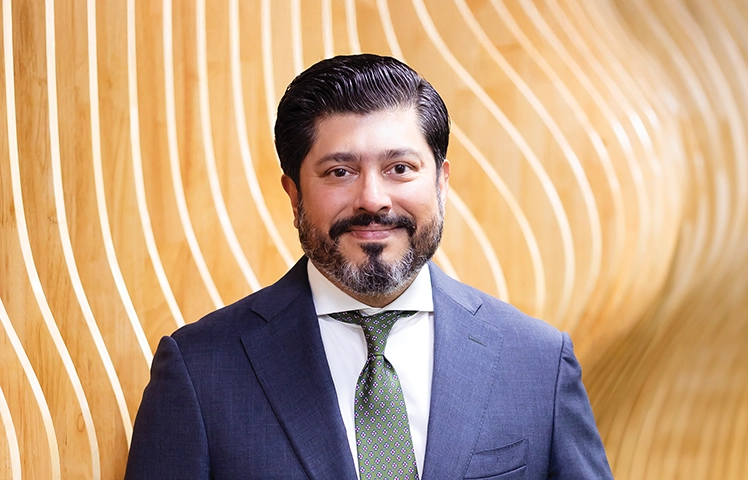

How would you describe FY 26 for Triveni? What made this year distinctive?
A. FY 26 has been one of our most consequential in recent years, where operating performance, strategic execution, and structural transformation came together.
On the performance front, we delivered consolidated revenue of ₹ 6,290.5 crores, up 10.6%, with EBITDA growing 16.9% to ₹ 623.8 crores, and Profit After Tax by 12.8% to ₹ 268.7 crores. This is particularly meaningful given the challenging operating context. On one hand, geopolitical conflict in West Asia disrupted global trade and dampened industrial activity across our engineering businesses; on the other, the sugar business saw an increase in cane prices and low availability.
The performance was largely driven by a strong turnaround in distillery operations, along with higher sales volume and realisations in the Sugar business. The Power Transmission Business (PTB) ended the year with a 25% increase in order book.
The most consequential development, however, was structural, as the Composite Scheme of Arrangement became effective in May 2026, following NCLT sanction. Sir Shadi Lal Enterprises Limited (SSEL) stands amalgamated with TEIL with effect from April 1, 2025, and the PTB will demerge into Triveni Power Transmission Limited (TPTL) with effect from April 1, 2026.
Can you elaborate on the challenges in the sugar business and the Company’s performance?
A. In a year that tested the industry at every level, resilience sums up the performance of the sugar business. The Sugar Season (SS) 2025-26 saw sugarcane crush decline by 8.8% to 8.25 million tonnes, primarily due to agro-climatic factors on yields in West Uttar Pradesh (UP) and aggressive diversion of sugarcane to local jaggery production in select areas. Furthermore, the UP state government implemented the largest cane price increase since season 2012-13 of ₹ 300 per metric tonne, putting significant cost pressure.
Happy to note that despite these challenges, our mills outperformed the state. We improved gross recovery by 26 basis points to 11.06% and sustained net sugar production at 0.91 million tonnes in SS 2025-26, despite the state’s average production declining 3.4%. Our Khatauli unit in West UP was the only one in the state to cross 2 million tonnes of cane volume crushed.
Revenue from the business grew 12.8% to ₹ 4,476.60 crores, supported by 10.4% higher dispatches and 3.8% higher realisations. Profitability held steady with PBIT growing marginally by 2.1% to ₹ 272 crores.
How did the Company navigate the challenges in the sugar business?
A. Our sugar business navigated challenges by focussing on the three levers: quality and quantity of cane, and the efficiency with which we convert it, and cost optimisation.
Intensive cane development initiatives in past years yielded excellent outcomes in improved yield and cane availability, taking into consideration various challenges such as red rot, water logging etc. At the same time, all units operated entirely on C-heavy molasses, given the favourable economics, based on prevailing/expected sugar realisation prices.
On the profitability front, higher sales volume, improved realisations and recoveries, and cost optimisation measures insulated margins against high cane prices. Average realisation increased 3.8% to ₹ 40,679/MT, supported by excellent sugar quality and product mix. Targeted capital expenditures were undertaken across Khatauli, Chandanpur and Rani Nangal units to optimise steam consumption, which showed encouraging results.
UPERC’s power tariff revision under the CRE Regulation 2024 further translated into an average increase of ₹ 1 per unit across our cogeneration units, contributing to an additional ₹ 31.2 crores of income in FY 26.
The Distillery segment saw a significant turnaround. Can you highlight the key developments and the factors that contributed to it?
A. The Distillery segment achieved an outstanding turnaround in FY 26. We posted the highest-ever alcohol production and sales volume, supported by better availability of grain feedstock and a substantial quantity of molasses purchased from external sources. Ethanol constituted 92% of our alcohol sales, with 56% production from grain-based feedstocks. Revenue net of excise was up 5.4% to ₹ 1,552.4 crores.
The highlight was a 200.8% growth in segmental PBIT to ₹ 119.3 crores, driven by higher volumes, cost optimisation, and materially lower procurement costs, particularly for maize. The performance reflects the strategic choices made several years ago, including building a resilient multi-feedstock platform and strengthening the supply chain to source, transport, and store feedstock efficiently at optimal cost.
Process improvement, efficiency and cost optimisation initiatives undertaken, include:
- Effective utilisation of enzyme at Sabitgarh and improved fuel efficiency at Rani Nangal and Milaknarayanpur
- Reduction in bagasse consumption at the molasses-based distillery at Muzaffarnagar through increased slop consumption
- Debottlenecking at Muzaffarnagar’s grain-based distillery, which increased production from maize and reduced power consumption by ~2,000 units/day.
In addition to this, the higher realisation price of DDGS (by-product) contributed to the increase in profitability.
We have tied up a solid allocation pipeline of 17.18 crores litres of ethanol supply under Cycle-1 of OMC tender and with Private OMCs, with the expectation of further allocations in the subsequent cycle. An additional 1.8 crores litres of ENA has been earmarked for potable alcohol.
On the IMIL side, we sold 58.9 lakh cases in FY 26, outperforming the broader industry growth metrics in Uttar Pradesh and consolidating our position among the top five players despite competition.
Turning to the Power Transmission business, how did the Company navigate geopolitical disruptions while ensuring business resilience?
A. FY 26 was a year of two distinct parts for PTB. The first three quarters were characterised by strong order momentum and healthy operational performance. However, the fourth quarter saw disruption due to the West Asia conflict. This delayed dispatches and order finalisation in both domestic as well as European and Middle Eastern projects, particularly in the Steam Turbine Generator segment.
The business saw an 8.1% decline in revenue to ₹ 339.9 crores, and 5.0% in PBIT to ₹ 120.4 crores. However, the true measure of our performance goes beyond numbers. We maintained PBIT margins at ~35%, even after absorbing incremental costs associated with the ongoing capacity expansion, reflecting operational discipline and the impact of cost optimisation. Order booking remained resilient at ₹ 467 crores, resulting in an order position of ₹ 485 crores as of March 31, 2026, providing strong revenue visibility.
The more meaningful indicators are the forward-looking ones. Let me first start with the gears business. A breakthrough was achieved in our internationalisation strategy. Our focus on the Middle East and European markets resulted in additional contracts from major oil and gas companies. We entered the Japanese market, delivering the first gearbox for a compressor test rig to an OEM.
In the aftermarket segment, a landmark order was received for the GTRE Axial Compressor Test Facility from a premier Defence establishment. This is the first of its kind in Asia and one of a few worldwide, and significantly enhances India’s indigenous capabilities in gas turbine engine development.
The business added 24 high-potential international customers, including marquee industry names. Importantly, even as order bookings in the business were impacted, the pipeline remains strong. The overall enquiry inflow doubled in the product segment, and grew by 46% in the aftermarket segment.
Moving to the defence business, the year saw us strengthening our foothold in the Indian defence industry with TPTL winning the orders for prestigious naval vessel program and participation in various other ongoing projects. TPTL is also building indigenous technology for various equipment in line with the Atmanirbhar policy of Govt of India, and few projects are also being pursued in collaboration with global OEMs.
These developments validate our in-house technology and capabilities, giving confidence in the potential this business holds.
How do you see the Power Transmission Business entering its new chapter as TPTL?
A. Starting FY 27, the PTB is entering its next orbit as a focussed, independent platform, Triveni Power Transmission Limited. The business has sufficient cash flows and a balance sheet strength to support its dedicated capital allocation. The growing enquiries from both global and domestic customers, proven technical competence, and cost efficiencies give us conviction in a sustained growth path and unlocking significant value for shareholders.
The capex program at our gear manufacturing capacity will be completed by September 2026, enhancing revenue potential from ₹ 400 crores to ₹ 700 crores. It positions us to address increasing global demand, improve delivery timelines, and scale both OEM and aftermarket segments. Our business is gathering international momentum, with the Middle East emerging as a key growth vector. Beyond that, our wholly-owned Swiss step-down subsidiary, Triveni Power Transmission GmbH, has broadened our customer connect and acceptance among European customers. The qualification orders for pumps and compressors supplied to major customers position us for deeper penetration in the Oil and Gas segment.
On the defence side, key machinery items have been installed and commissioned at our new multi-modal Defence manufacturing facility in Mysuru. Our long-term positioning as an indigenisation partner gives us confidence in the immense potential the segment holds.
Additionally, the business is also undergoing significant digital transformation. We have initiated the implementation of CRM and a smart factory solution, while the ERP is being migrated to a more cutting-edge SAP HANA platform. This positions the PTB as a next-generation, technologically advanced player with enhanced operational efficiency and competitiveness.
How did the Water business perform, and where is the opportunity ahead?
A. The Water business delivered adequate performance with a 14.6% increase in revenue to ₹ 268.5 crores, driven by accelerated EPC execution.
Two developments deserve attention. First, the successful completion and handover of the EXIM Bank-funded Maldives water and sanitation project covering six islands, which demonstrates our capability to deliver on international turnkey mandates. Second, an outstanding order book of ₹ 1,503 crores, of which ₹ 1,077 crores is towards long-duration O&M contracts, having multi-year revenue visibility.
The water sector offers significant opportunities, given the gap between water demand and current treatment capacity. Stricter enforcement of zero liquid discharge (ZLD) norms and the introduction of the Liquid Discharge Management Rules 2025 have accelerated industrial demand, creating new opportunities in recycle, reuse, and ZLD.
FY 26 saw the Company’s progress in margin improvement and cost management. What is our approach in the coming years?
A. Our approach to the bottom line has been deliberate and integrated into the way we run our business, rather than just being cyclical in nature. It rests on four pillars.
First, sustained cost optimisation across every business. Across our Alcohol and Sugar businesses, we are driving procurement discipline alongside capex to modernise facilities, improve fuel efficiency, drive efficiencies, and enhance by-product recovery.
Second is product mix improvement. PTB is increasingly transitioning toward larger, higher-value gearboxes. In the sugar business, we are improving mix towards high-quality, premium products. The alcohol business is targeting premium and super-premium consumer segments through IMFL. In the water business, we are targeting more complex EPC projects across international markets, alongside a mix that includes long-duration O&M.
Third is driving operating leverage from higher utilisation. As we continue ramping up the recently commissioned Rani Nangal distillery, improve utilisation of existing distilleries through improved feedstock availability, and bring online our expansion and new projects to enhance gears and defence business, unit costs will decline meaningfully.
Lastly, costs will be optimised through the use of technology and digital enablement. The completion of digital transformation at PTB will drive higher efficiencies. In the sugar business, we continue to leverage AI and digitisation for crop health management, improving agronomic practices and efficient cane procurement logistics. We have planned a hybrid yield prediction model, leveraging AI/ML to augment the traditional regression framework and improve cane yield estimation. In water, IoT-enabled treatment plant monitoring is improving service reliability.
Each of these cost and productivity drivers will compound over time, resulting in more sustainable margins.
Can you comment on the Company’s balance sheet and capital allocation discipline?
A. Our balance sheet remains strong. Our consolidated gross debt as on March 31, 2026, stood at ₹ 2,147 crores, as against ₹ 1,969 crores in the previous year, reflecting our capex-led growth investments and build up of sugar inventories which will progressively reduce in line with its sales. The average cost of funds on standalone basis during the last quarter of the fiscal year has declined by 90 basis points at 6.6% p.a. as compared to similar period of the previous year.
What is more encouraging is the reaffirmation of our long-term rating as AA+ (Stable) by ICRA, an upgrade from the earlier AA+ (under watch, with developing implications) that provides vote of confidence in our corporate restructuring.
We continue with our track record of prudent capital allocation. During FY 26 (based on Standalone Financials), we generated ₹ 456 crores in cash, which was deployed across three priorities, including reinvestment in growth, working capital to support growing operations, and returns to shareholders. Of this, ~56% (₹ 258 crores) was channelled in growth capex, 30% (₹ 138 crores) for working capital needs, and ₹ 60 crores has been earmarked for shareholder returns. This includes the interim dividend of ₹ 1.50 per equity share already paid during the year, and the final dividend of ₹ 1.25 per equity share recommended by the Board. This takes the total dividend for the year to ₹ 2.75 per share, in line with our payout policy of 15-25%.
What are the immediate priorities as the Company enters FY 27 as two separate platforms? What should be the takeaway for the shareholders?
A. FY 26 marks the culmination of a multi-year journey, and the beginning of the next one. With the Composite Scheme of Arrangement coming into effect, we advance into FY 27 with a new structure that will allow both TEIL and TPTL to be valued for what they are and pursue their dedicated growth paths.
The priorities remain clear. In the Sugar and Alcohol business, we will continue strengthening the raw material foundation by accelerating cane varietal substitution in remaining areas, deepening farmer engagement, and further improving recoveries. Precision agriculture initiatives, deeper engagement with our 3,60,000+ farmer community, and continued facility modernisation will remain central to our next phase of growth. At our distilleries, capacity utilisation and multi-feedstock flexibility will remain key to steady operations, complemented by the emerging opportunity from the government’s vision of enhancing ethanol blending beyond 20%. In the IMIL and IMFL businesses, we will continue brand building and scaling distribution.
The outlook for the water business remains positive. The focus will be on converting the enquiry pipeline into orders across areas such as recycle and reuse, Zero Liquid Discharge (ZLD), Hybrid Annuity Model (HAM) projects.
In the Power Transmission Business, which is now vested with TPTL, the priority will be to commission the expansion programs, tap international opportunities, and build out the aftermarket and defence platforms.
I thank each of our shareholders for wholeheartedly supporting us through this transformation. Going forward, we will continue to build both companies with the same discipline and passion. We will continue to be guided by the philosophy of building for India and creating value for stakeholders that have defined us for the last nine decades.