
Advancing climate resilience through resource-efficient operations, lower-carbon growth pathways, and reduced dependence on fossil fuels


Responsible production through promoting circularity, effective resource utilisation and creating value from co-products


Embedding integrity, accountability, and ethical practices through strong governance practices

Creating shared value through community development and social empowerment


Integrating sustainability considerations into capital allocation and business decisions towards resilient value creation
Natural resources conservation through sustainable water, energy, and environmental management practices


Environmental
Sustainability at the source
Carbon footprint reduction
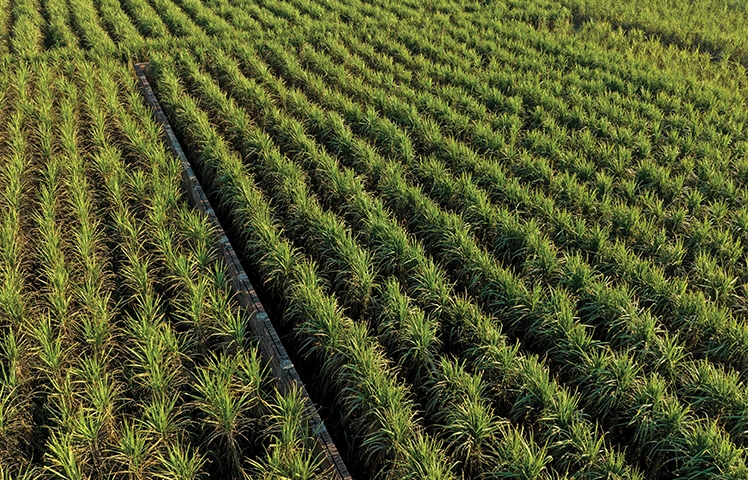
Carbon reduction is embedded across our businesses. In sugar operations, a 104.5 MW grid-connected bagasse-based (a renewable fuel which has no net addition of CO2 in atmosphere) cogeneration plant helps meet the captive power requirement, with surplus power sold to UPPCL. Ethanol production at our distilleries contributes to India’s blending targets and reduces fossil fuel usage.
At our plants, measures like transition to LED lighting, drawing ~85% captive power from wind generation, and deployment of variable frequency have optimised energy and fuel consumption. We further prioritise fuel-efficient sea transport and limit the use of diesel generators for back-up power.
Air pollution management
We have deployed advanced pollution control technologies across sugar and distillery operations to maintain air quality as per statutory norms, minimising impact on surrounding communities and ecosystems. Key technologies deployed include:
- Bag filters for incineration boilers in distilleries
- Electrostatic precipitators and wet scrubbers on steam boiler stacks at sugar units for particulate and gaseous emission control
- Installation of continuous monitoring systems
Water and wastewater management
Our operations are designed to minimise water consumption, both internally and externally.
Our Distillery and Power Transmission businesses are zero liquid discharge (ZLD), supported by investments in water treatment plants and incineration boilers. Besides water treatment, our operations recycle and reuse water in operations, reducing fresh water draw and preventing soil degradation.
The PTB has 8 lakh litres of rainwater harvesting capacity, which is used for cooling and gardening. Further, all wastewater is treated as per regulatory norms before discharge or reuse.
Beyond our operations, our water and wastewater business delivers a range of ZLD, recycling, reuse, and treatment solutions using the latest technologies. These assist municipalities and industrial clients in effectively managing critical water resources. Our partnership with the CII, CII Triveni Water Institute, is focussed on advancing India’s water security agenda through stakeholder engagement and using innovative tools.
Advancing the circular economy
Our operations are designed to effectively manage waste and to generate wealth from waste. Gearbox oil and lubricants used by our power transmission business for manufacturing and testing are collected, stored, and sent for recycling through State Pollution Control Board-approved vendors. We also cater to aftermarket requirements, including Gearbox refurbishment and parts replacement, which extend product life, reduce material waste and eliminate the need for full replacement.
Our sugar and alcohol businesses have established circular value chains focussed on repurposing co-products generated during operations. This mitigates environmental concerns and also generates value by turning waste into resources.
Circular value chain in sugar and alcohol operations
| Co-products | Repurposing |
|---|---|
| Bagasse | Fuel for power cogeneration for captive use and grid sales (surplus) |
| Molasses | Feedstock for ethanol production and ENA for potable and industrial purposes |
| Press mud/filter cake (a residue of cane processing rich in convertible substrates) | Bio-fertiliser supplied to farmers, and sold to renewable biogas producers through anaerobic digestion |
| Distillers’ Dried Grain Solubles (DDGS) (a byproduct of the ethanol production process from grains) | Used as a livestock feed, rich in protein and energy |
| Potash-rich ash (Derived from slop incineration, a concentrated spent wash, which is a by-product of ethanol manufacturing) | Granulated and sold for potash fertiliser production, supporting India’s potash self-sufficiency |
| Carbon dioxide (CO2) | At Sabitgarh plant, CO2 from the fermentation is captured, compressed and sold as liquid CO2 and dry ice |
| Fly ash (generated during the steam and power production) | Sold for fly ash brick manufacturing/soil enrichment |
Enabling sustainable farm productivity
We engage farmers to embed sustainable agriculture practices that improve yields and long-term farm viability, while reducing environmental impact.
Our three-pillared approach to farm sustainability
Enhancing Soil Health
- Supporting balanced nutrient management and custom fertiliser recommendations through soil health assessments
- Encouraging in-field residue management to enhance organic content, while reducing instances of stubble burning
Improving resource efficiency
- Promoting efficient irrigation to optimise water consumption
- Precision fertiliser application practices, based on soil health, optimising fertiliser use and improving soil productivity
Climate-smart agriculture
- Encouraging natural, integrated pest management, which is sustainable and reduces chemical dependence
- Promoting intercropping to improve resource utilisation, enhance yields, and strengthen farm incomes
- Weather intelligence that informs crop cycles
Responsible and resilient sourcing
We integrate sustainable practices in our value chain operations to source materials ethically and responsibly. This mitigates ESG risks and builds resilience into the system, supporting steady, long-term operations.
How sustainable sourcing is ensured across businesses
Sugar business
- Vendor selected based on performance and sustainable criteria
- GPS and geofencing-enabled logistics for real-time tracking and route optimisation, lowering fuel consumption
- Efficient and sustainable bagasse flow from captive sugar units to cogeneration facilities
Outcome
Efficient supply chain | Reduced emissions | Optimised costs | Reliable feedstock movement
Alcohol business
- Feedstock (molasses, sugarcane juice/syrup, and grain) sourced from our own sugar mills and the market, near our distilleries
- Monitored and streamlined transport arrangements
Outcome
Reliable feedstock availability | Operational continuity | Optimised logistics
Power Transmission business
- Comprehensive vendor evaluation covering past performance, adherence to contractual requirements, cost competitiveness, compliance with statutory laws, and commitment to our EHS standards, including waste reduction, productivity enhancement and continuous improvement
- Orders placed with qualified vendors based on criticality and performance ratings
Outcome
Supply chain reliability | Quality and cost competitiveness | Reduced operational risks
Water business
- Comprehensive framework for vendor evaluation, onboarding and capability building
- Maintaining an approved vendor list for sourcing custom-engineered materials and direct site deliveries
Outcome
Expedited sourcing and project execution | Quality focus
Social
Empowering people who shape the nation
Advancing farmer prosperity
Farmers are partners in our operating model. Their socio-economic development and advancement contribute to our business success and the nation’s food security.
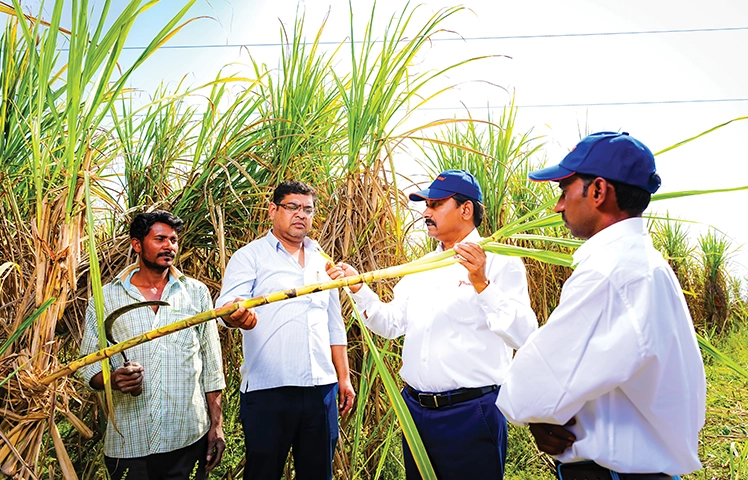
We support farmers through farmer-centric initiatives and engagement across the crop cycle. We have set up a large number of demo plots to showcase best economic practices, optimised irrigation, and planting geometry to obtain superior output. We offer a soil testing solution alongside recommendations for site-specific fertiliser, irrigation and farming techniques, and subsidised organic inputs like press mud.
Our cane development programme has been instrumental in protecting farm income through assistance in varietal substitution. Over the past few years, we have contributed substantially towards replacing the red rot disease-prone Co0238 cane variety with other high-yielding, disease-resistant sugarcane varieties. Farmers have benefited from more resilient crops. Through our partnership with the Sugarcane Breeding Institute, Coimbatore, we continue to research varietal evaluation and selection trials that can further enhance farm yields.
Technology deployment has been a game-changer in empowering farmers. We have made significant advancements in hyperlocal weather intelligence, IoT and GPS-enabled crop monitoring, AI-powered disease detection, and drone-based surveillance and pesticide spraying. Efforts are underway to enhance their adoption to drive change at scale. Our dedicated Cane Development Portal and Mobile App offer 24x7 assistance on farm issues, agro-advisory and weather updates. A digital dashboard provides training in plantation techniques and crop cycles, market information, precision farming methods and resource optimisation. These efforts are bringing precision agriculture into every farmer’s hands, resulting in higher yields and resilient farm incomes.
Partners behind engineering excellence
Our engineering customers operate in industries where uptime is non-negotiable, and the cost of failure is high. We combine our decades of engineering expertise with investments in advanced digital technologies, proactive R&D and partnerships with global experts to deliver best-in-class, reliable solutions. We offer customers the advantage of lower costs, faster delivery and higher productivity. Beyond products, we offer responsive aftermarket support and operations and maintenance that ensure longer asset life and higher returns on investment. We have further deployed a robust information security framework to protect proprietary customer data.
Building the talent that builds the businesses
Our businesses are built on deep sectoral expertise. We therefore continually invest in structured upskilling and engagement programmes to deepen domain expertise and build leaders for the next phase of growth. The health, safety and well-being of our employees are non-negotiable across every facility. We ensure this through world-class operational practices and safety systems to minimise occupational hazards, alongside regular audits and training. In FY 26, LTIFR stood at Nil in FY 26 vs 1.68 in FY 25.
Diversity, inclusion, and a culture of execution underpin every aspect of operation. Employee well-being is ensured through a supportive work culture, rewards and recognition and providing growth opportunities.
Inclusive community development
Advancing Community Healthcare
Tirath Ram Charitable Hospital worked to strengthen access to quality healthcare through preventive programmes for economically weaker sections in Delhi, including:
- Screened 638 women for cancer, osteoporosis and anaemia, providing free diagnostic investigations and medical consultations
- Preventive health check-up programme, where 800 young girls were screened for developmental and behavioural problems
- Screened 600 newborns for congenital disorders and hearing impairment for early detection
Our four mobile healthcare vans (Mobile Chiktisa) delivered affordable and accessible primary healthcare services to rural communities in Uttar Pradesh in association with Jubliant Bhartia Foundation. Over 11,637 individuals benefited from access to essential medical care.
We also conducted eye and dental health camps for caddies in association with Caddies Welfare Trust.
Improving access to quality education
TEIL supported schools in Deoband and Khatauli which provide free/subsidised education to children from the local communities. We also provided computers to enhance learning environments and upgrade education standards.
Empowering women at Nursing School
We provided financial support to the Nursing School of a hospital, contributing to improving teaching standards and enabling skill development.
Promoting Grassroots Sports
We supported India Youth Soccer Association, an NGO promoting football among the economically disadvantaged communities. Its Josh Rural project supported children and coaches from Football Academies across villages and small towns in North India with kits, footballs and training equipment. 629 boys and girls benefited with better coaching and talent nurturing.
Governance
Governed with integrity. Built with trust.
TEIL is built on the solid foundation of disciplined governance practices, allowing us to build businesses and create value for our stakeholders over the long-term. Our Board comprises over 62.50% independent directors, coming from diverse backgrounds and bringing a breadth of perspective.
Transparency and ethical practices are non-negotiable across every business and relationship. We ensure this through well-defined policies and practices, which are reviewed regularly and enhanced consistently. Our Code of Conduct guides all our actions, with zero tolerance for breaches. All employees have read the Code, and regular training is provided to reinforce it.
A robust enterprise risk management framework identifies, monitors, and mitigates risks, with oversight by the Board’s Risk Management Committee. We have further deployed a robust cybersecurity and data protection framework to protect both TEIL’s data and the proprietary information our customers entrust to us.
In FY 26, we reported zero instances of regulatory breaches, noncompliance, ethical violations, or whistleblower complaints.